Difficult for me to imagine what it would be like to have to live life picking through rubbish.
http://www.bbc.co.uk/news/magazine-30880085
Wednesday, 21 January 2015

Monday, 12 January 2015
The Lenborough Hoard, observations
Culture 24 has interviewed Ros Tyrell the Finds Liaison Officer who was present when the Lenborough Hoard was found. I've always had respect for FLO's as ultimately they've put the archaeological time in to get qualifications that I as a detectorist haven't.
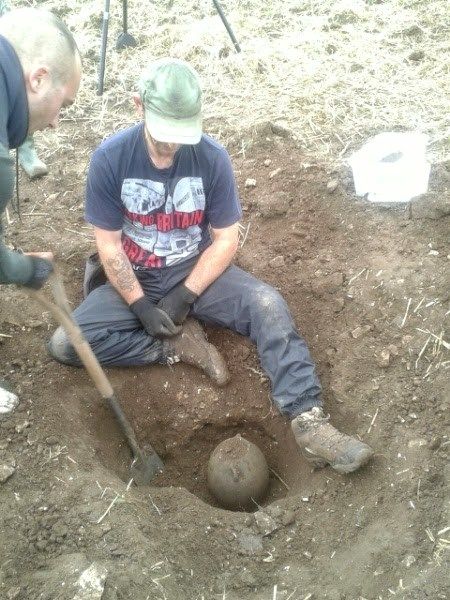
Having a FLO on site when a hoard was found I thought would therefore be a perfect opportunity for archaeologists to show what should be done. I was therefore rather surprised when I saw this picture.

Rightly or wrongly my preconceptions about how a hoard would be dug with a FLO on site wasn't like this picture rather they were something like

I mean to me hoards are once in a lifetime things, they are very rare opportunities to learn things that can change British History forever. Sure they might not but well if you don't do it properly how do you know. I was therefore very interested to learn why the FLO and a club who state they are
'... a professional, well run organisation' should excavate the over 5,500 Anglo Saxon coins with their heads stuck down a hole that only seems to be big enough to get just what can be seen out (if I have anything factually wrong here please let me know).
I was hoping that the Culture 24 article might explain why heads in a hole was deemed to be the preferable method of excavating. Unfortunately having read the article I as detectorist have more questions than answers, something which is rather depressing and leads me to believe that a great opportunity to bridge the gap between archaeologists and detectorists may have been missed. My questions and observations from the article are as follows.
Even two coins are treasure, as long as they're 300 years old, but it was clear that it was going to be more complicated 'cos there were a couple of bits of lead early on, which suggested there was more in there than we could see.
I got the finder to enlarge the hole, because it was very small. Their protocol is to dig the smallest hole you can because then you don't have to fill too much back in.
- No mention of digging below the plough line here. That bit of PAS guidance always gets ignored once it's a hoard. Have I dug below the plough line, yup, but not as much as I could. Should I have some of my reward reduced because of this, probably.
I'm not quite as young as I once was and I can't get down and kneel and do things like that, like I used to be able to. The detectorist and his son did the digging and we covered up the original site of the find with a plastic bag so we weren't messing it up as we cut around the hole.
- Hrm ok well you're the FLO, you are the example that I as a detectorist should follow. So if I find a hoard I don't need to call in the Archie's but rather get out my plastic bag?
As we came level with the top of the coins it was clear there were more than just a few.
By then I was lying on my front in the grass. I couldn't not get involved by then, I needed to get down and see it.
They were wrapped in a lead parcel, which I thought was very strange – turns out there have been lead pieces come up with other coins hoards in that period.
It was an oblong of finished lead sheet which had been folded over in a sort of cylinder. The ends folded over each other to seal it and then the two short ends were pinched closed.
It looked like a giant pasty, really: like how you would cook a piece of chicken in tin foil in the oven. It's a very simple, cheap way of wrapping your coins up so that you don't sacrifice a vessel.
You could do it on the table in your house, I suppose. It may well be that they had cheap lead lying around.
- Ok so the lead parcel doesn't really matter then it seems, just what's in it? I thought from my 'Archaeology is rubbish' that context of a find matters, like how it was put there etc. Guess not.
At a quick glance, which is really all that's been done so far, all I can say is they were probably coins of Cnut or Æthelred, anything around that period.
Ideally we would have launched the story after we'd done our investigations. But it was all over the internet by Monday morning, well out of control.
- Isn't it the responsibility of the professional well one club to have some sort of protocol to stop this sort of thing? Dear God if I ever found a hoard I'd probably be on the phone to my missus as soon as i've recovered from fainting but I would try and resist the urge to advertise what I've found in real time to the planet. Could you stop the other detectorists from throwing it up on the net though I wonder?
I was on Christmas leave by then, but I had to do the lifting because there was nobody else to do it, basically.
- So in the case of finding the hoard there is no special protocol or system that the British Museum or PAS as whereby the hoard can be protected it seems. Odd as I would have thought the odds of a hoard being found were largest on a Sunday when clubs are out.
I did it with the help of the finder. The landowner was kind enough to take the sheep out of the field. He'd been warned that there was something going on and kept updated, but he was dealing with his sheep to get ready for the market, which as far as he was concerned was much more important.
- So the landowner was kind enough to take the sheep out the field but didn't give permission to dig the hoard in any other way or indeed help protect it until it could be dug?
We did, in fact, use his kitchen table to make an initial count of the coins that night. With everybody else being on holiday there would not have been anyone else to help anyway.
I had to work on the Monday to bring the stuff into the museum because I didn't want it at home, especially over Christmas. I don't think my house insurance would have paid it.
- I'm not sure you could actually make that last point up. Sadly I was already aware of it. What this means is if you hand anything over to the FLO and it's stolen or they lose it then the FLO could be personally liable for the loss. Surely they need to be insured for this sort of thing.
I've been an FLO for more than 11 years and I've never had anything quite like that before, but we got it sorted out fairly quickly. I didn't feel happy to keep them very long – they went to the British Museum fairly soon after that.
My colleague took them up in the museum van with a driver, because we weren't that keen on sitting on the train with them. It's quite heavy, that many coins.
- Don't know why but the thought of a bloke sitting on a train with a million quids worth of coins amuses me.
They're safe and sound in the British Museum now, and their conservation lab is cleaning the coins and lead, ready for Gareth Williams, the Curator of Medieval Coins, to identify them and do a report for the coroner, who can't rule on them until he's got an archaeological report.
We have to wait with bated breath for that. There's no way we could have identified more than a couple in the circumstances. You can't tell when they're muddy, although they're in very good condition.
Certainly they were packed in a tight little parcel – you wouldn't believe that many coins could be in such a small parcel.
- So I was just wondering at this point why they weren't removed with or in the parcel, is this naive of me?
Wrapping them in lead had worked – it preserved whoever's money it was for a lot longer than they'd planned. They never came back for them.
If I'm right about Cnut, the latest one would be 1035, which is the end of his reign. It might be an early or late one, there are different types.
It's so early in the game weEr really haven't had a chance to research any of this. I'm not sure of the full significance of any of this at the moment, it's too early to tell.
It's an exceptional find – one of the biggest in the country. It's the biggest hoard of any sort in Buckinghamshire.
- So it's an exceptional find, one of the biggest in the country, but again perfectly ok to take out of the parcel and put in bags within the course of a day? I'm a detectorist, they are the FLO so I presume so.
We've had medieval pennies and a Roman hoard, but not as many and they weren't in as good condition. It's certainly the prettiest hoard, if you like coins.
The museum would like to acquire them for the people of Buckinghamshire. Whether we can afford them is another matter.
The money being bandied about in the press is totally unreliable. What they're really worth remains to be seen and will not be decided until the Treasure Valuation Committee has met and come up with a fair market value.
I hope they're not worth more than £1 million. We don't have that sort of spare money – does any museum, come to that?
- Well you could hope for a kindly detectorist / farmer who waive some of their reward.
The Keeper of Archaeology will be working on that one. We'll be seeking to raise the funds when the time comes, but it's all very much in the balance.
The coin specialist was on leave, as well. I've hardly had any Christmas holiday at all, what with the press chasing me.
I was driving back for New Year and thought I'd left something behind, but it was a guy from the Daily Mail. The difficulty is in saying something coherent when you've had your mind on other things for three or four days.
Sometimes being an FLO does impinge on your private life a bit. The press did get a bit overexcited.
- Er you've just found perhaps one of the biggest hoards ever found, do the FLO's get any media training?
While we were trying to dig we were surrounded by metal detectorists peering down the hole taking photographs on their iPhones. It was quite difficult to work.
- Hrm can't blame them really, but a professional well run club should perhaps have made it a little easier for the FLO to work and the detectorists should have realised the need for the FLO to do a proper job.
Archaeological people have criticised me for digging it there and then but there was no way we could guard that hoard overnight. Would there have been anybody to come and help?
- Well if the farmer had managed to get the sheep out the field then maybe he could have come over with a bloody big tractor or something. Oddly I always thought the British Museum might have some sort of protocol for this sort of thing, like one man and his tent who could come up and guard the findspot or something!
I'm sorry but I find this a daft statement really as would have thought the farmer would have let the club organiser / finder stay the night to get some help the next day when the other detectorists had left. Am sure work would have understood.
It was just too public, so it had to be lifted and sorted out as best we could. Sometimes FLOs work in difficult conditions.
- Hrm this is a real shame as it seems to me that it was the dectorists and the club here that seem to be the difficult conditions. I may be wrong here but what else are the 'difficult' conditions.
We'd rather have had an excavation done slowly and gently, but even then you can be metal detected by nighthawks as soon as you've gone home – I'm afraid they don't care about whether it's a proper excavation or not. They can easily sweep in when your back's turned.
- Ah ok so it wasn't ideal. Not being rude again but wouldn't you er like get overtime if you didn't go home. I would have thought there would be some protocol again for the FLO or someone staying and guarding the find if the farmer couldn't drive his great big tractor over the find spot.
If you look at the YouTube footage it makes it look like we're 'tee-hee, yum yum, giggle giggle', shovelling the stuff out in a hurry and scooping the coins out in handfuls.
It really wasn't like that. It took us all day – we only just got it in before the light went, we worked hard and slowly on it. We were lucky the lead was in such good condition.
I think somebody in the press said they were in a lead bucket, which definitely wasn't the case. It was a parcel.
The finder could have kept quiet about it, although it would have been difficult to put it in your pocket and sneak away with it – it would have made your trousers a funny shape.
We've organised for him to go up to the museum and see the conservation lab while they're cleaning some of his coins early next week. He's quite excited about it all.
There are bad guys out there who give the hobby a bad name. People don't always report things, although one likes to think that most detectorists are aware of the Portable Antiquities Scheme and their responsibilities.
You can tot up that a silver coin of that period costs so much and then multiply it by 5,000 but that's not really how it works. It might be that the rest of the hoard is full of unusual coins. It's a real unknown quantity.
I think the PAS is launching its treasure report early in February and they were hoping that Gareth would have done at least the initial report by then. That would actually be quite quick for a treasure report.
I'd like to be able to say it'll be done by a certain date, but Gareth would probably kill me. I'd be found with a trowel or a set of coin scales between my shoulderblades.
We hope to tell people the whole story eventually: what it was doing in Buckinghamshire, whether it was minted at the Buckinghamshire mint – there's lots to finds out. It's tantalising.”
Hrm now I'm a bit confused as it would appear that the FLO wanted extra time so it could be dug properly but the Weekend Wanderers website says ' Also a special mention should be made of FLO Ros Tyrrell for spending hours on the ground doing a proper excavation and overseeing that all was done correctly'.
It's a shame as that there are these conflicts in whether things were done properly or not as it only fans the flames of the anti-dectorist brigade and perhaps rightly so. Maybe the FLO felt overwhelmed by the detectorists and / or a seeming lack of any formal protocol for this sort of this thing. It's undeniably a wonderful find but I hope that in the rush, however it was caused, hasn't meant that knowledge of how and why it was put there in the first place hasn't been lost forever.
Monday, 5 January 2015
Metal Detecting on BBC 4 Farming Today
There was an interesting little piece on Radio 4's Farming Today about metal detecting (4 mins in).
A few comments on it.
1. Not all items are recorded as the piece says, only items over 300 years old that are voluntarily reported to a Finds Liaison officer (FLO) who work for the Portable Antiquities Scheme (PAS) are recorded. There is no legal requirement to report finds to a FLO. Many detectorists do not report their 300 years old to their local FLO.
There is a legal requirement to report possible Treasure to the local Coroner. Usually Treasure finds are reported the local FLO instead of the Coroner as they act as a go between. The legal requirement to report possible treasure come from the Treasure Act 1996.
2. Any responsible detectorist should have their own specific insurance rather than relying on the farmers public liability insurance. If I was a farmer I would want to see the detectorists insurance.
3. If the farmer is interested in the history of their land they may wish to make sure they ask the detectorist to show them everything that they have found and make sure items are recorded with the FLO.
A farmer might also wish to ask the detectorist to print out and show them some of their personalised PAS finds records (A detectorist can create a username on the PAS website and the finds that they record can get linked to the username. This shows it was the detectorist that reported the find).
4. As to 'lucrative diversification' then a farmer should be aware that it's not just shinny coins that are worth money. Beehive thimbles, buckles, spurs, crotal bells and all sorts of other things can be commonly found by detectorists and can be worth a fair few quid. Some detectorists might think that they can buy you off with a bottle of whiskey in exchange for them not showing you stuff they then keep / sell without you knowing.
A few comments on it.
1. Not all items are recorded as the piece says, only items over 300 years old that are voluntarily reported to a Finds Liaison officer (FLO) who work for the Portable Antiquities Scheme (PAS) are recorded. There is no legal requirement to report finds to a FLO. Many detectorists do not report their 300 years old to their local FLO.
There is a legal requirement to report possible Treasure to the local Coroner. Usually Treasure finds are reported the local FLO instead of the Coroner as they act as a go between. The legal requirement to report possible treasure come from the Treasure Act 1996.
2. Any responsible detectorist should have their own specific insurance rather than relying on the farmers public liability insurance. If I was a farmer I would want to see the detectorists insurance.
3. If the farmer is interested in the history of their land they may wish to make sure they ask the detectorist to show them everything that they have found and make sure items are recorded with the FLO.
A farmer might also wish to ask the detectorist to print out and show them some of their personalised PAS finds records (A detectorist can create a username on the PAS website and the finds that they record can get linked to the username. This shows it was the detectorist that reported the find).
4. As to 'lucrative diversification' then a farmer should be aware that it's not just shinny coins that are worth money. Beehive thimbles, buckles, spurs, crotal bells and all sorts of other things can be commonly found by detectorists and can be worth a fair few quid. Some detectorists might think that they can buy you off with a bottle of whiskey in exchange for them not showing you stuff they then keep / sell without you knowing.
Friday, 2 January 2015
To all new fortune seekers!
To all you budding new treasure finders please note that 99.999 pct of days are spent finding things like
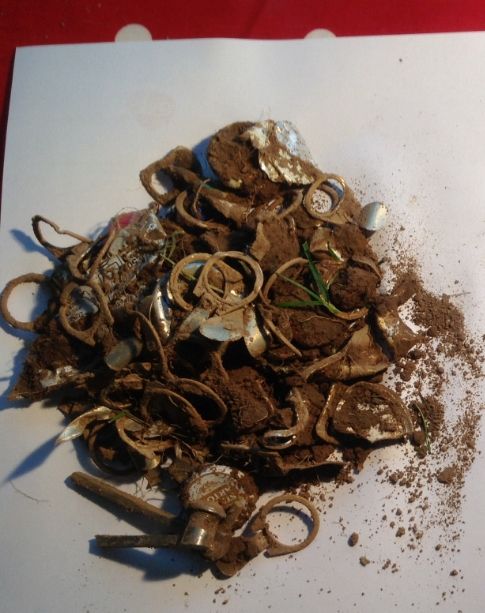 |
| Lots of these and |
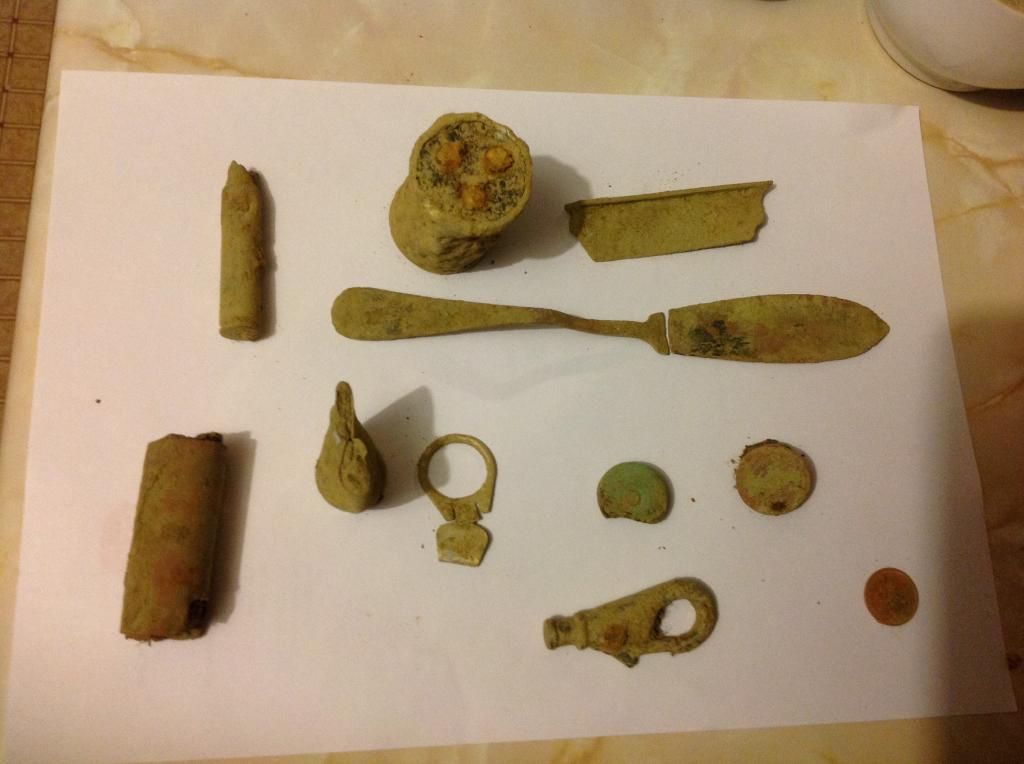 |
| Stuff like this |
If you are new and have any questions then please post them and I'll do my best to answer.
Thursday, 1 January 2015
Aylesbury hoard of Anglo Saxon Coins in the news
Old news to many now I imagine but just noticed the first more mainstream media mention of the Aylesbury hoard found on 21 December 2014. (no comments on it being the Daily Mail!)
You can read more about the hoard on the Weekend Wanderers website.
You can read more about the hoard on the Weekend Wanderers website.
Tuesday, 30 December 2014
Back in time at the beach
Christmas done, DIY done, finally a trip to the beach.


Arriving at the beach it was a lovely sunny day, no wind, no other folks about. Lovely.
About 90 minutes later I hadn't found didly, apart from random small bits of copper. Still was great just being out so decided to carry on. About 30 minutes later I came hit my first coin, a 1949 six pence. I then proceeded to dig out quite a few more coins in the same area of the beach. Weirdly they all dated from around 1940 to 1960. Nothing decimal at all. Still shouldn't be that surprised as this beach seems to be decimal up one end and then gradually gets older (oldest coin i've found there is 1870 something).
Happy with my little pre-decimal hoard I carried on when I got a lovely loud 'ding ding' two bars from the top of my euro-ace. I didn't need to dig as laying on the ground was what seems to be a gold signet ring. Bit of an odd one in that I don't know if it's solid or just gold plated. There isn't a hallmark and it's rather cruddy inside. Still have popped up a post on The Metal Detecting Forum so hopefully somebody will know more than I which when it comes to gold ain't hard.
I carried on for another hour so and found a pound coin and a 10 pence piece before deciding to head home. All in all a lovely 4 hours out.
Whilst I haven't done much beach detecting at all one thing I often find is that where you find one coin you will often find more close by so always have a good look around the hole.
Have a good new year all.


Wednesday, 24 December 2014
Happy Christmas
Hi,
Would just like to wish all readers a Happy Christmas and New Year. Will start blogging again over Christmas!
Cheers
Would just like to wish all readers a Happy Christmas and New Year. Will start blogging again over Christmas!
Cheers
Monday, 13 October 2014
Viking hoard
Just a small piece about a recently unearthed treasure find.
http://www.dailymail.co.uk/news/article-2790197/metal-detectorist-finds-britain-s-biggest-haul-viking-treasure-hundreds-artefacts-including-ancient-silver-cross.html
http://www.dailymail.co.uk/news/article-2790197/metal-detectorist-finds-britain-s-biggest-haul-viking-treasure-hundreds-artefacts-including-ancient-silver-cross.html
Thursday, 2 October 2014


Wednesday, 24 September 2014
Monday, 22 September 2014
Who's inside the Tomb?
An interesting article on the BBC about an excavation in Greece.
http://www.bbc.co.uk/news/world-europe-29239529
Can't blame the locals for wanting it to be Alexander the Great. Hopefully the team are filming it all for a future documentary.
http://www.bbc.co.uk/news/world-europe-29239529
Can't blame the locals for wanting it to be Alexander the Great. Hopefully the team are filming it all for a future documentary.
Friday, 19 September 2014
Woo some land
Haven't posted for the last 4 months as well life's been busy and I haven't really had any land to go on that i haven't done a lot (my fault as I haven't really looked!)
Anyway thanks to a kind offer of a work colleague I now have 12 acres to do so hopefully there will be more posts soon.
Cheers
Anyway thanks to a kind offer of a work colleague I now have 12 acres to do so hopefully there will be more posts soon.
Cheers
Wednesday, 21 May 2014
Meeting the heritage crime officer
So today I travelled to Battle in East Sussex to meet with PC Daryl Holter who is one of the Heritage crime officers who cover both East and West Sussex. Unfortunately the chief inspector couldn't make it as he'd been called away but i had an excellent chat with Daryl about all things Heritage crime.
As I understand it Sussex Police have only had Heritage Crime officers, who do have other non Heritage Crime duties to, for 18 months so they are a fairly new team.
At the moment the teams focus is on spreading awareness of what Heritage Crime is amongst the residents of Sussex by going out and about meeting farmers, archaeologists, PAS staff, detectorists etc. At the moment reports of Heritage Crime are quite low but at it's impossible to know how much of this is down to the public's lack of knowledge about what Heritage Crime might be and that they can ring 101 or indeed 999 if they want to report an incident. The ringing 999 point is interesting as it was Daryl's view that should one see someone detecting let us say next to Battle Abbey then they would want to respond as quickly as possible and that Heritage Crime should be treated just like any other crime.
Daryl's experience of nighthawkers was that they fell into two categories, the ignorant and the more 'professional' dedicated nighthawker. Part of his job is therefore to educate the ignorant as to why they can't just detect where-ever they want. I think the job of education is something that responsible detectorists, detecting groups, NCMD, PAS and detector manufacturers etc can all perhaps do more to help with.
With the more professional nighthawkers it's trickier as whilst it is a case of evidence and intelligence gathering it's not always possible to get enough evidence for a prosecution. However having a word with a possible suspect to let them know they are on the Police's radar can be an effective way of getting them to stop. Daryl did however say that they have had very few reports of nighthawking, but again it's difficult to know the reasons behind this.
With regard to information on a nighthawking crime scene Sussex Police work closely with County archaeologists and the local FLO who help out with regards to information about the area that affected with regards to it's history and to identify what may have been found on the suspect.
It was interesting to learn about the different types of crime they have to deal with especially a spate of post box thefts. Apparently some of the old post boxes can be worth hundreds or thousands of pounds and are stolen to order for people who want them as an ornamental 'feature'.
We did briefly discuss licensing and this wasn't something that they had considered.
Daryl kindly gave me the contact for my local Heritage Crime officer so I will be in touch with them next to see what's happening on my doorstep!
All in all a good day.
As I understand it Sussex Police have only had Heritage Crime officers, who do have other non Heritage Crime duties to, for 18 months so they are a fairly new team.
At the moment the teams focus is on spreading awareness of what Heritage Crime is amongst the residents of Sussex by going out and about meeting farmers, archaeologists, PAS staff, detectorists etc. At the moment reports of Heritage Crime are quite low but at it's impossible to know how much of this is down to the public's lack of knowledge about what Heritage Crime might be and that they can ring 101 or indeed 999 if they want to report an incident. The ringing 999 point is interesting as it was Daryl's view that should one see someone detecting let us say next to Battle Abbey then they would want to respond as quickly as possible and that Heritage Crime should be treated just like any other crime.
Daryl's experience of nighthawkers was that they fell into two categories, the ignorant and the more 'professional' dedicated nighthawker. Part of his job is therefore to educate the ignorant as to why they can't just detect where-ever they want. I think the job of education is something that responsible detectorists, detecting groups, NCMD, PAS and detector manufacturers etc can all perhaps do more to help with.
With the more professional nighthawkers it's trickier as whilst it is a case of evidence and intelligence gathering it's not always possible to get enough evidence for a prosecution. However having a word with a possible suspect to let them know they are on the Police's radar can be an effective way of getting them to stop. Daryl did however say that they have had very few reports of nighthawking, but again it's difficult to know the reasons behind this.
With regard to information on a nighthawking crime scene Sussex Police work closely with County archaeologists and the local FLO who help out with regards to information about the area that affected with regards to it's history and to identify what may have been found on the suspect.
It was interesting to learn about the different types of crime they have to deal with especially a spate of post box thefts. Apparently some of the old post boxes can be worth hundreds or thousands of pounds and are stolen to order for people who want them as an ornamental 'feature'.
We did briefly discuss licensing and this wasn't something that they had considered.
Daryl kindly gave me the contact for my local Heritage Crime officer so I will be in touch with them next to see what's happening on my doorstep!
All in all a good day.
Sunday, 18 May 2014
Some gold at the beach
So I went to the beach with my little man on Saturday as it was a lovely day. He's only just turned 4 so it's nice to take him to the beach to do some 'treasure hunting' together. He likes it when daddy gets a signal so he can help dig the hole. We usually only about an hour together and as the hour usually involves other playing such as 'running away from the sea' and throwing stones in the sea we only usually dig about 10 or 15 holes.


Well the first hole we dug together had a pound coin in it (which later got spent on the postman pat ride in the arcade).
The second hole had the below in it. Was rather surprised to say the least!
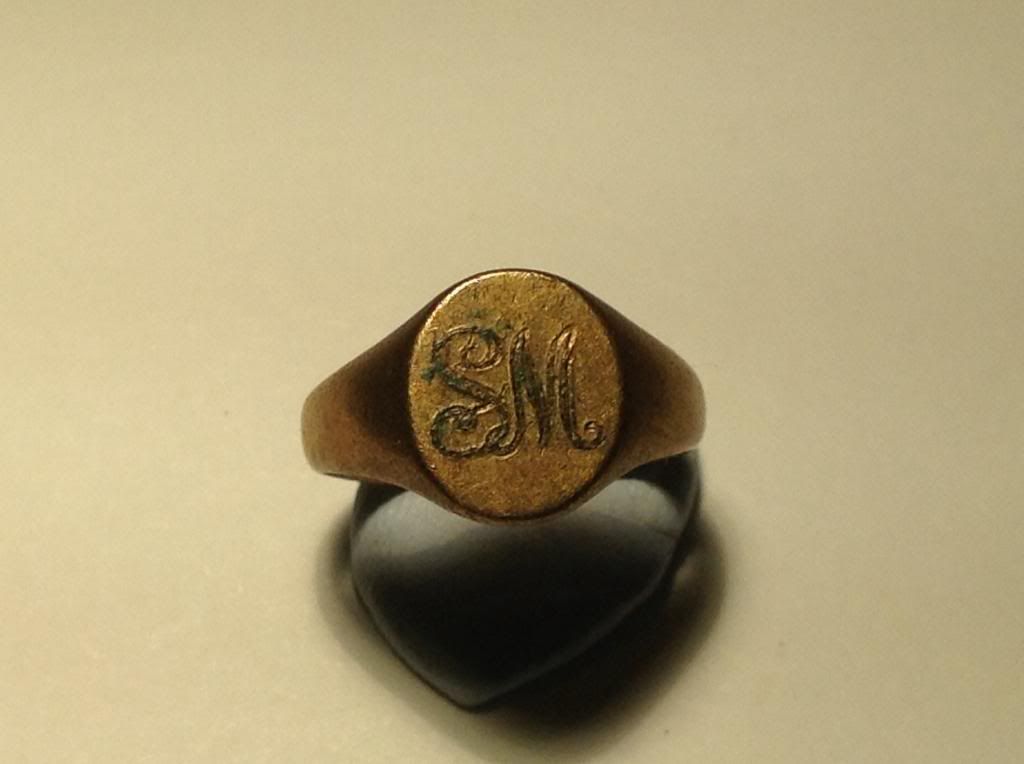

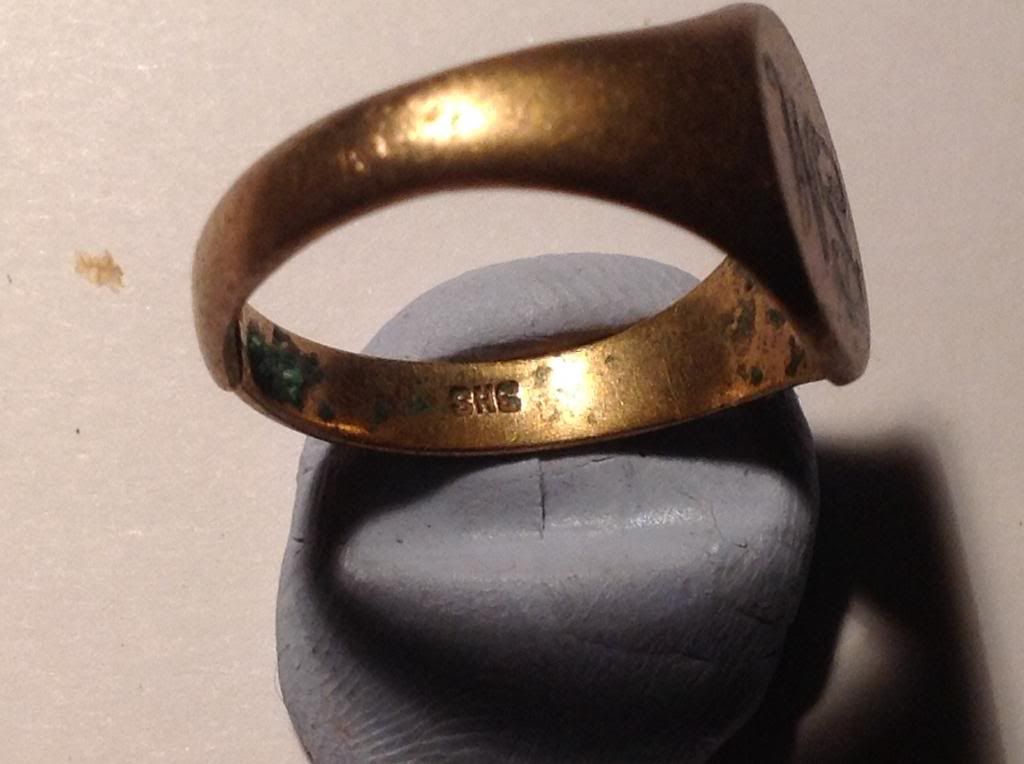
I'm not sure how the old ring is. It could be 1861 or 1936 or something else. I believe the maker is Samuel Hill although I'm slightly confused as to whether Samuel Hill is the same as H Samuel the high street jeweller so any assistance greatly received! It certainly looks like it has been through the wars.
We then proceeded to dig out some more pound coins and quite oddly 6 pre-decimal sixpences and a nice button after which we were both quite hot and so went for some sausages and chips at the cafe which is his favorite.

Lovely day.
Friday, 16 May 2014
Little thread on detectorists and farmers
Just came across the following thread about some farmers views on detectorists. Was interesting. Shame to see some farmers having such poor experiences with some detecting morons.
http://thefarmingforum.co.uk/index.php?threads/trying-to-get-in-the-head-of-a-farmer.20796/
http://thefarmingforum.co.uk/index.php?threads/trying-to-get-in-the-head-of-a-farmer.20796/
Wednesday, 14 May 2014
First face to face permission request
Driving back from a meeting today I saw a farm shop advertising its apple juice. Being a lover of apple juice I popped in to buy some. I also plucked up the courage to ask the farmer for permission to detect. He didn't say no and asked for my details so fingers crossed.
This was the first time I've done a face to face ask and it was kind of scary. I found myself waffling about how I do try my best to be a responsible detectorist and that everything that I find is his so he can set the terms for what to do with the finds etc.
Ah well, am prepared for a lot of no's but if you don't ask then you don't get and I've been whinging about the fact I could do with some more places so figured I should stop and get out there and get some.
This was the first time I've done a face to face ask and it was kind of scary. I found myself waffling about how I do try my best to be a responsible detectorist and that everything that I find is his so he can set the terms for what to do with the finds etc.
Ah well, am prepared for a lot of no's but if you don't ask then you don't get and I've been whinging about the fact I could do with some more places so figured I should stop and get out there and get some.
Tuesday, 13 May 2014
So putting your hand on it and pulling isn't good?

'bleep, bleep'
or in the case of my euroace
'ding, ding'
Dig, dig, dig
See something poking out the side / bottom of the hole
Put your hand around said object and pull
Bugger it broke.
Now I have to admit that I've broken objects in my haste to see what they are. I imagine that other detectorists have done the same.
Fortunately I haven't broken anything particularly valuable but I'm rather ashamed of the fact I've broken anything and also aware that I don't actually know how to dig something out properly if required.
With this in mind I've popped myself on a day course at The Sussex School of Archaeology entitled 'First Aid for Finds'. At £40 I didn't think this was to bad for a day course and hopefully I might learn something about digging and conserving finds (yes I'm aware isn't all going to be metal).
Does this mean if I ever find a hoard I'll dig it out myself, nope. Leave that to the experts.
I just want to be slightly less inept at digging and conserving stuff!
Sunday, 11 May 2014
A hammered day, whopee
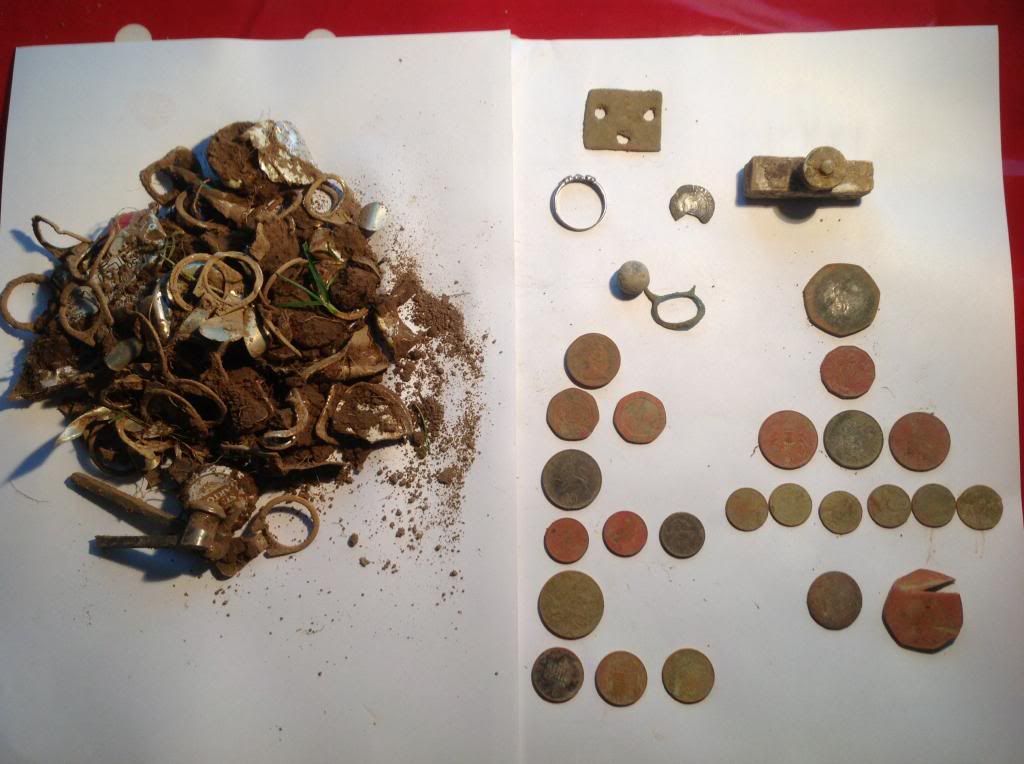
Thanks to a kind offer from the missus I managed to get in some detecting time today. I was undecided where to go but eventually decided on a local park where I have a licence to detect. The fun thing about this parks is that you certainly get a lot of signals. The not so fun thing about this park is that most of the signals tend to be this


After about 20 ring pulls I got another signal which was 3 bars from the top like all the ring pulls. Oh well 1 less ring pull to find later I thought as I dug the hole.
'Well I'll be' I thought to myself as I poked around in the hole as looking back at me was a little silver coin. Looked like a chunk had been taken out of it but there was the unmistakable writing around the edge of a hammered coin.

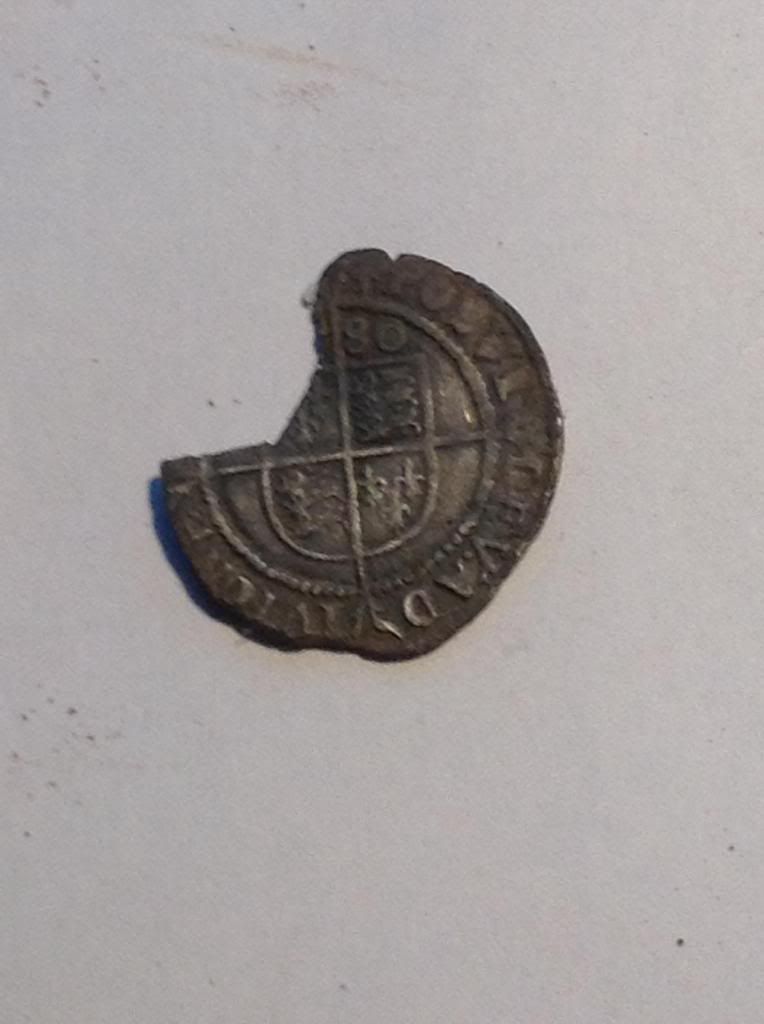
I love the feeling of finding something unexpected, it's a definite buzz that makes you forget about all the cr*p that you find.
Anyway so I gently took it out the hole and saw it was a nice little Elizabeth I sixpence (I think!) dated 1580. The detail on it is great and whilst it's a shame it's damaged I don't really care as I won't be selling it anyway. It's also my first Lizzy sixpence.
Spurred on by the hammy I carried on for another 3 hours or so and had a good time but no more hammy's not that I was really expecting one! I did find a nice little old buckle piece (another for the Finds Liaison Officer, FLO, box), a musket ball, a ring (which sadly is costume jewelry), a weird thing that almost looks like a bicycle brake (another for the FLO to look at) and some pre and post decimal coins. Oh and a whole lot of ring pulls.
A lot of folks don't like doing parks because of the general public, I can understand this, but actually I quite chatting to people who have always been polite and interested.
Thursday, 8 May 2014
Some questions about archaeological recording
I was reading a post on The Heritage Journal in regard to the archaeological 'clearance' of a Bronze Age Pond Barrow.
The BBC article linked in the post mentions that
The BBC article linked in the post mentions that
'Archaeologists spent three years excavating it and found thousands of items and
remains, indicating the site had been continuously lived on since the end of the
last ice age.'
Now apologies for being ignorant but when, presumably commercial, archaeologists come in to do these sorts of excavations how do they usually share their findings? Am I being presumptuous in thinking that they do have to share their findings? Also where do all the thousands of items and remains go?
I appreciate the article says that a synopsis of the findings would go on an information board but I was just wondering where the whole report and all of the finds go.
Subscribe to:
Posts (Atom)