Committee members are wanted for the Treasure Valuation Committee. Details here. closing date 25th April 2014.
Whilst they seek someone to represent the views of finders, especially metal detectorists they don't want you to use a metal detector whilst a Committee member. This is discussed on the Metal Detecting Forum here where I read the news first.
Tuesday, 8 April 2014

Just a bear?
Slightly off topic but on Sunday I had a different form of detecting session. I took my 3 year old out for the day and we went out for some food, a walk and then to a local farm shop.
As we got home he asks 'where's Alfie?' his favourite bear. 'Oh god'. So I drive back to all the places we had visited but no bear. He spends Sunday night sobbing himself to sleep. We desperately try to see if there are any similar bears on the internet to buy as whilst it wouldn't be the same it might help, however no joy.
On monday morning as the farm shop had been closed I drive back there but no bear, again.
I get home and as I'm walking down our street on the phone to my partner giving her the bad news I see a little brown bundle, sodden, sitting on a wall. It's Alfie.
All is well with the world.
To many that bear is just a tatty old thing. To my little man he's everything.

As we got home he asks 'where's Alfie?' his favourite bear. 'Oh god'. So I drive back to all the places we had visited but no bear. He spends Sunday night sobbing himself to sleep. We desperately try to see if there are any similar bears on the internet to buy as whilst it wouldn't be the same it might help, however no joy.
On monday morning as the farm shop had been closed I drive back there but no bear, again.
I get home and as I'm walking down our street on the phone to my partner giving her the bad news I see a little brown bundle, sodden, sitting on a wall. It's Alfie.
All is well with the world.
To many that bear is just a tatty old thing. To my little man he's everything.
Sunday, 6 April 2014
Think I hit the dump
Was out detecting for a few hours yesterday. Went into a little forested bit of the permission and found what has to be their old dumping ground. only dug a few bits that were pretty much on the surface. Oddly I found myself thinking the Local archaeology club might like to dig it. Must be this blogs influence as never thought such things before.

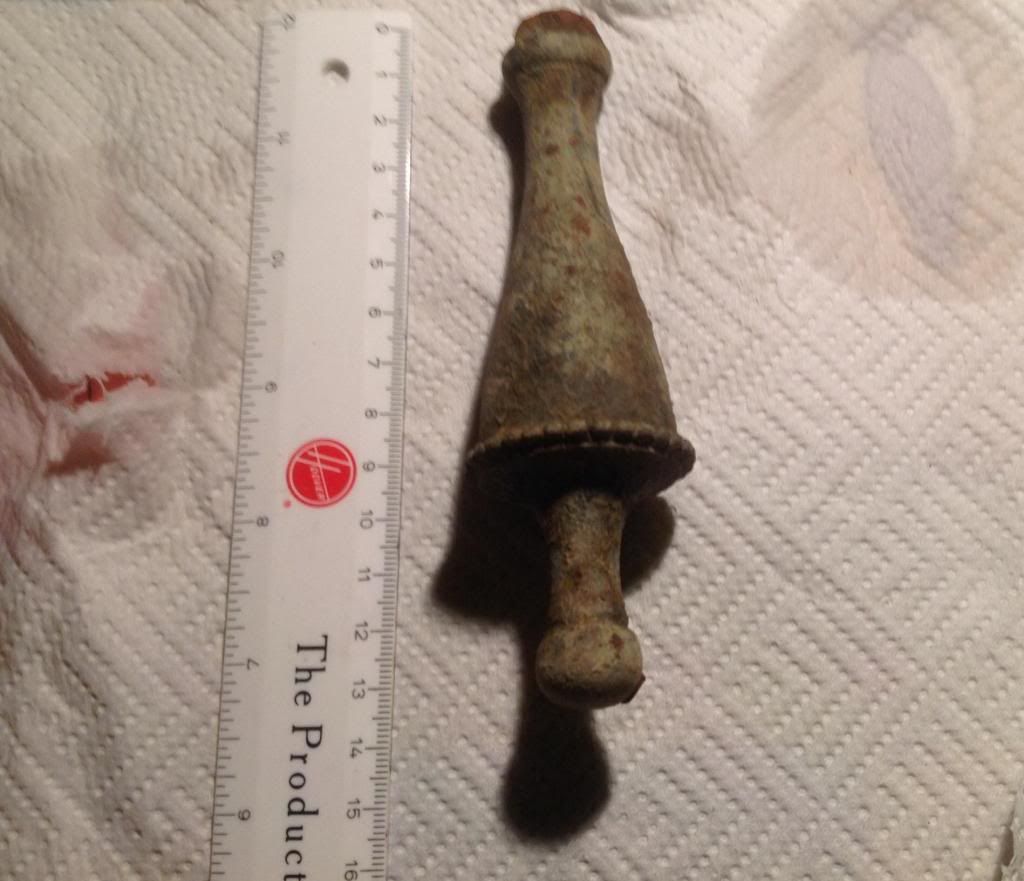
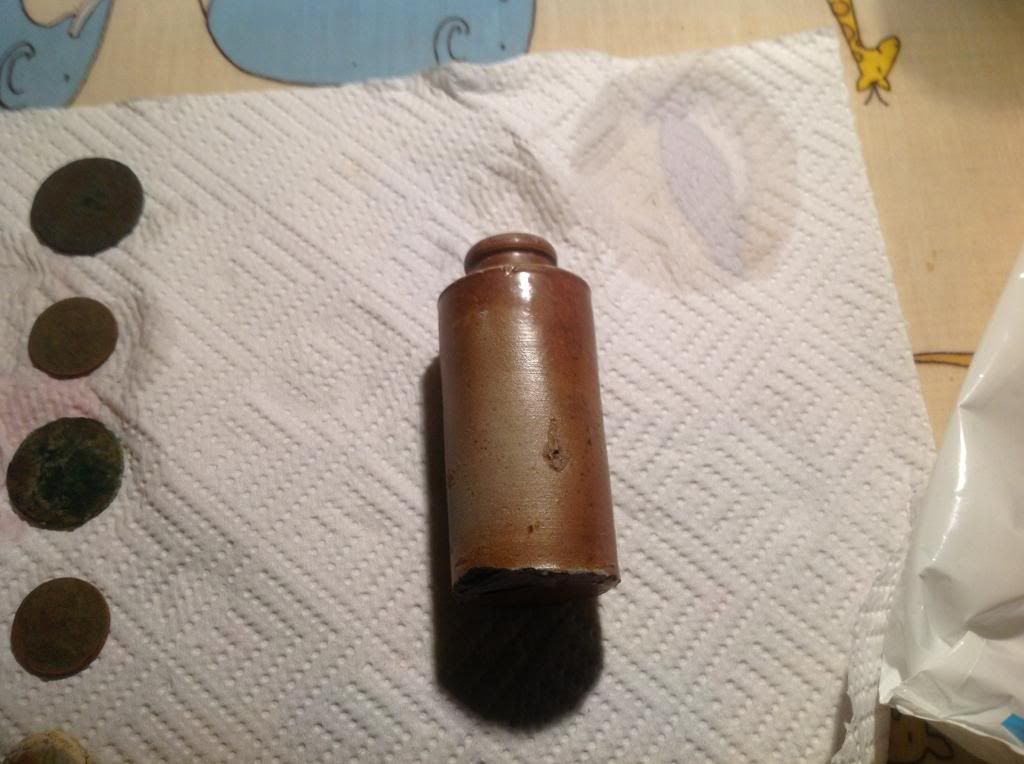
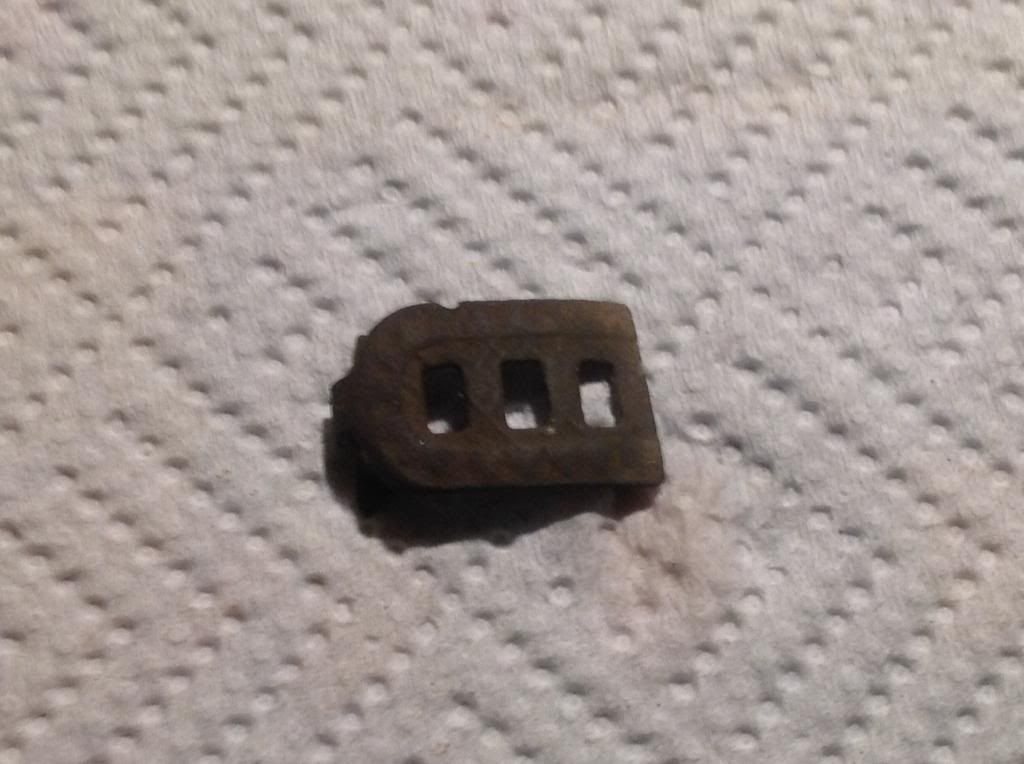
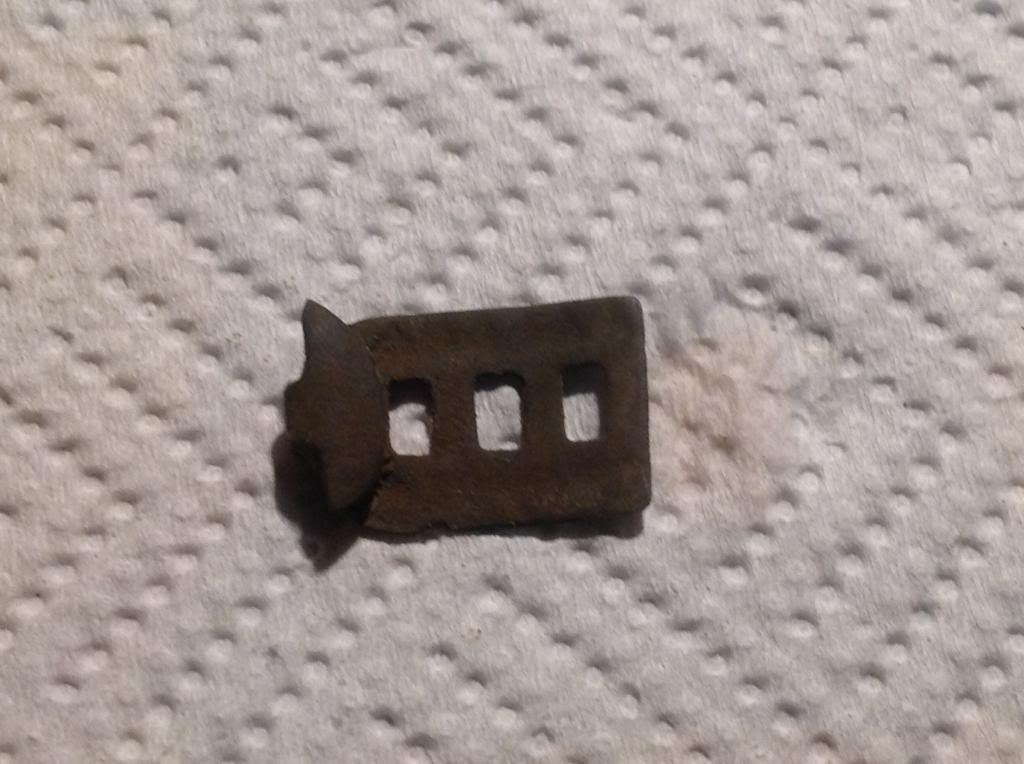
Found a nice little brown bottle laying on the surface and a piece of broken pottery to try and identify seems to say 'dogrose'. also found what looks like a door knob or something and an old bit of a clip perhaps. I shall pop them up on a metal detecting forum as there are lots of kind folks who will help identify things.


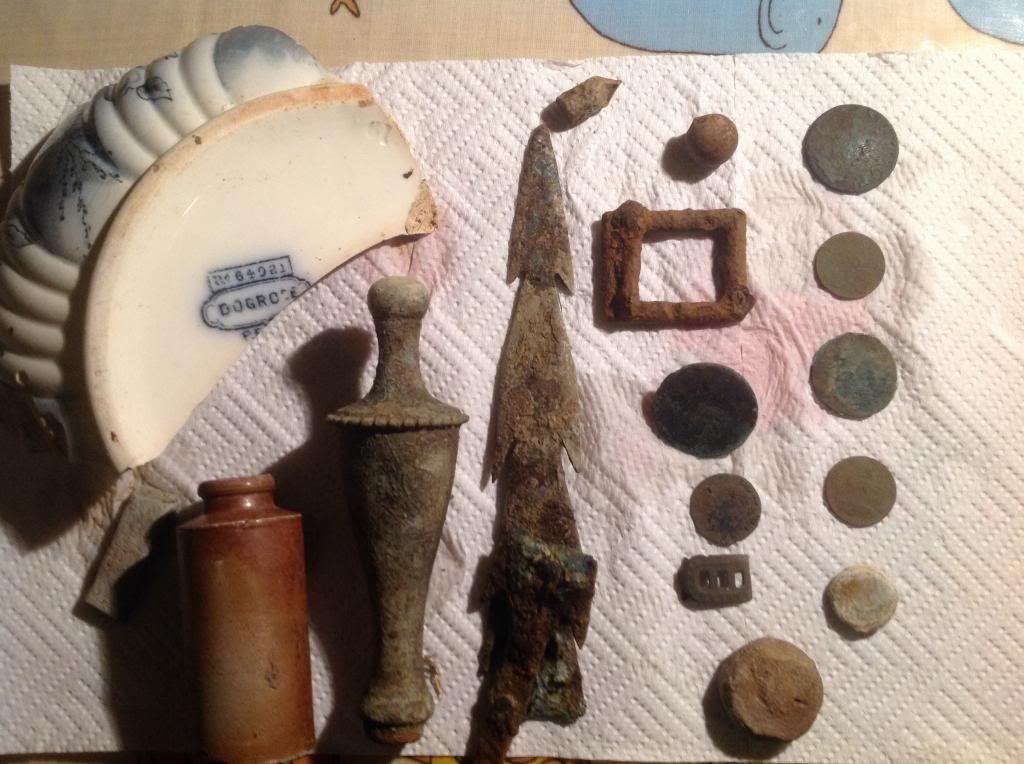
Found a nice little brown bottle laying on the surface and a piece of broken pottery to try and identify seems to say 'dogrose'. also found what looks like a door knob or something and an old bit of a clip perhaps. I shall pop them up on a metal detecting forum as there are lots of kind folks who will help identify things.
Saturday, 5 April 2014
Metal Detecting For Beginners - Insurance
So you've bought your metal detector and want to get out into the field that you've secured permission to detect on.Wait a moment. What happens if you accidentally put your spade through a water pipe or telephone cable? Could be expensive!
For the price of a few pints of beer you can get insurance to help pay for any unfortunate expenses you might occur in the course of your metal detecting.
The National Council Of Metal Detecting (NCMD) will insure you for just 8 quid a year. Not only do you get insured but you become a member of the Official Representative body for Metal Detectorists and a newsletter.
If you are thinking about joining a metal detecting club then they will probably want you to be insured to
 |
| Hrm this might cost me a bit |
The National Council Of Metal Detecting (NCMD) will insure you for just 8 quid a year. Not only do you get insured but you become a member of the Official Representative body for Metal Detectorists and a newsletter.
If you are thinking about joining a metal detecting club then they will probably want you to be insured to
Thursday, 3 April 2014
There is no versus.
Deep Digger Dan is a popular detectorist. He has 47k odd subscribers and over 200 odd videos. A lot of people listen to what he says. He represent's for the want of a better word a lot of detectorists. On 1st April 2014 Dan had put out a video about detectorists vs archaeologists.
There are over 100 comments on the video. There is also discussion about the video on Detecting Wales and Paul Barford's blog.
From my experience I do not share Dan's point of view.
I don't believe there is any archaeologists vs detectorists war nor should there be. What there should be more of is debate regarding how metal detectorists can best work with archaeologists and vice versa with the realisation that detectorists and archaeologists are not completely separate homogeneous groups.
Where I disagree with Dan is that I think that if an archaeologist is going to spend years studying the best way to conserve history then they deserve the respect that their studies bring. Whilst they might not be right, just because they criticise some detectorist's practices doesn't mean they are all being 'snooty'.
Many detectorists spend half an hour buying a detector and then say they are 'conserving history'. Isn't an archaeologist entitled to wonder and question just how they think they are doing this?
What Dan does not discuss is the fact that, nighthawkers aside, detectorists are not the same. Many detectorists don't report treasure finds, many don't care about the plough line, many don't show their Finds Liaison Officer their finds over 300 years old, those who think an SSSI is some sort of sexually transmitted disease and the many don't give a stuff about anything that isn't silver or gold. It is right to question if these practices make for 'bad' detectorists only marginally below nighthawkers.
An archaeologist or indeed a fellow detectorist should therefore be able to show what metal detecting practices are not exactly 'conserving history' or that 'history hunting' with a metal detector might not actually be in the best interests of society without being accused of starting a war or breaking some weird unwritten tribal metal detecting code.
Just as an archaeologist can ask questions of detectorists practices then so to a detectorist is free to ask questions of an archaeologist and in my experience the responses to such questions have been fair and respectful. No war at all.
Many archaeologists will recognise that many of the recent hoards that have been found have been through metal detecting. Great this is just one point, it does not in my opinion justify the wholesale failure to record 1000's of other items as maybe society has lost more with these unrecorded items?
It is not a simple question of archaeologists vs detectorists as there is no us and them,I think there are just differently weighted perspectives on what constitutes the best way to conserve history. Perhaps the more we as metal detectorists learn the more weight our arguments might hold?
There are over 100 comments on the video. There is also discussion about the video on Detecting Wales and Paul Barford's blog.
From my experience I do not share Dan's point of view.
I don't believe there is any archaeologists vs detectorists war nor should there be. What there should be more of is debate regarding how metal detectorists can best work with archaeologists and vice versa with the realisation that detectorists and archaeologists are not completely separate homogeneous groups.
Where I disagree with Dan is that I think that if an archaeologist is going to spend years studying the best way to conserve history then they deserve the respect that their studies bring. Whilst they might not be right, just because they criticise some detectorist's practices doesn't mean they are all being 'snooty'.
Many detectorists spend half an hour buying a detector and then say they are 'conserving history'. Isn't an archaeologist entitled to wonder and question just how they think they are doing this?
What Dan does not discuss is the fact that, nighthawkers aside, detectorists are not the same. Many detectorists don't report treasure finds, many don't care about the plough line, many don't show their Finds Liaison Officer their finds over 300 years old, those who think an SSSI is some sort of sexually transmitted disease and the many don't give a stuff about anything that isn't silver or gold. It is right to question if these practices make for 'bad' detectorists only marginally below nighthawkers.
An archaeologist or indeed a fellow detectorist should therefore be able to show what metal detecting practices are not exactly 'conserving history' or that 'history hunting' with a metal detector might not actually be in the best interests of society without being accused of starting a war or breaking some weird unwritten tribal metal detecting code.
Just as an archaeologist can ask questions of detectorists practices then so to a detectorist is free to ask questions of an archaeologist and in my experience the responses to such questions have been fair and respectful. No war at all.
Many archaeologists will recognise that many of the recent hoards that have been found have been through metal detecting. Great this is just one point, it does not in my opinion justify the wholesale failure to record 1000's of other items as maybe society has lost more with these unrecorded items?
It is not a simple question of archaeologists vs detectorists as there is no us and them,I think there are just differently weighted perspectives on what constitutes the best way to conserve history. Perhaps the more we as metal detectorists learn the more weight our arguments might hold?
Wednesday, 2 April 2014
Metal Detecting for beginners - Treasure
Whilst in UK it is lawful to buy a metal detector and then with the landowners permission go out metal detecting there are laws for what you have to do with some of the stuff you find. The below applies to finds made in England and Wales. Northern Ireland and Scotland have there own rules
1. TREASURE

The Portable Antiquities Scheme (PAS) gives the definition of treasure as
If you think you've found the holy grail, a Saxon gold ring or medieval silver buckle then you can't just sell it as the item may be considered Treasure which in effect means the item or items are to historically important to belong to you and should belong to the nation. The UK is good enough to reward you for finding treasure (you can waive this), but if you don't follow the Law and guidance on finding treasure that reward might be reduced or taken away completely.
The Treasure Act 1996 sets out the Law regarding Treasure. The Code of Practice that goes with the Treasure Act sets gives the full in depth guidance as to what you should do if you find what you think might be Treasure. The PAS website has a shorter leaflet for what you should do if you find treasure.
The first and most important step is that any possible treasure find MUST be reported to the Local Coroner within 14 days, this is usually done by contacting your local Finds Liaison Officer (FLO), do that and you've made the first start in recording your possible treasure item. You could face a £5000 fine and / or 6 months imprisonment if you don't report a find.
If you are out digging and come across what might be a hoard, say a container full of silver coins, then you should stop digging and call your Local FLO. If they aren't in try the British Museum or a different FLO. Contact details can be found here or on the PAS leaflet. Why should you do this? Well because if you just dig the container out the ground the 'context' of the find will be lost. IE it may be harder to tell how it got there in the first place or who put it there and as such it would be better if your find is removed by trained archaeologists (don't worry you'll still be considered the finder even if they find other bits whilst they are digging).
Why should you care? Well if you don't you shouldn't be detecting but ultimately if you do just hoick it out then you may have your reward taken away from you for irresponsible.
If you've gone to the effort of buying a detector and securing permission for land to detect on then you can spend an hour learning what you should do if you find what might be treasure.
1. TREASURE
The Portable Antiquities Scheme (PAS) gives the definition of treasure as
- Any metallic object, other than a coin, provided that at least 10 per cent by weight of metal is precious metal (that is, gold or silver) and that it is at least 300 years old when found. If the object is of prehistoric date it will be Treasure provided any part of it is precious metal.
- Any group of two or more metallic objects of any composition of prehistoric date that come from the same find (see below)
- Two or more coins from the same find provided they are at least 300 years old when found and contain 10 per cent gold or silver (if the coins contain less than 10 per cent of gold or silver there must be at least ten of them). Only the following groups of coins will normally be regarded as coming from the same find: Hoards that have been deliberately hidden; Smaller groups of coins, such as the contents of purses, that may been dropped or lost; Votive or ritual deposits.
- Any object, whatever it is made of, that is found in the same place as, or had previously been together with, another object that is Treasure.
Any object that would previously have been treasure trove, but does not fall within the specific categories given above. Only objects that are less than 300 years old, that are made substantially of gold or silver, that have been deliberately hidden with the intention of recovery and whose owners or heirs are unknown will come into this category.
Note:An object or coin is part of the'same find' as another object or coin if it is found in the same place as, or had previously been together with, the other object. Finds may have become scattered since they were originally deposited in the ground.
If you think you've found the holy grail, a Saxon gold ring or medieval silver buckle then you can't just sell it as the item may be considered Treasure which in effect means the item or items are to historically important to belong to you and should belong to the nation. The UK is good enough to reward you for finding treasure (you can waive this), but if you don't follow the Law and guidance on finding treasure that reward might be reduced or taken away completely.
The Treasure Act 1996 sets out the Law regarding Treasure. The Code of Practice that goes with the Treasure Act sets gives the full in depth guidance as to what you should do if you find what you think might be Treasure. The PAS website has a shorter leaflet for what you should do if you find treasure.
The first and most important step is that any possible treasure find MUST be reported to the Local Coroner within 14 days, this is usually done by contacting your local Finds Liaison Officer (FLO), do that and you've made the first start in recording your possible treasure item. You could face a £5000 fine and / or 6 months imprisonment if you don't report a find.
If you are out digging and come across what might be a hoard, say a container full of silver coins, then you should stop digging and call your Local FLO. If they aren't in try the British Museum or a different FLO. Contact details can be found here or on the PAS leaflet. Why should you do this? Well because if you just dig the container out the ground the 'context' of the find will be lost. IE it may be harder to tell how it got there in the first place or who put it there and as such it would be better if your find is removed by trained archaeologists (don't worry you'll still be considered the finder even if they find other bits whilst they are digging).
Why should you care? Well if you don't you shouldn't be detecting but ultimately if you do just hoick it out then you may have your reward taken away from you for irresponsible.
If you've gone to the effort of buying a detector and securing permission for land to detect on then you can spend an hour learning what you should do if you find what might be treasure.
Tuesday, 1 April 2014
Update on the PAS Volunteer expansion lottery bid
Further to my post about the PAS's bid to expand its volunteer base here I have received a response from Claire at the PAS who is happy for me to publish her email which gives a bit more detail about the scheme.
We are currently developing a funding bid to the Heritage Lottery Fund to widen the PAS volunteer base and reach new audiences in local areas, in the process increasing the PAS’ capacity to record finds. The PASt Explorers: finds recording in the local community project has passed the first round funding bid and we are now in the development phase, aiming to submit the second round bid in April and if we are successful, to start the project in November 2014.
The project aims to create community finds recording teams based around local FLOs. There will be one FLO who will act as lead FLO in a 'Regional Training Centre', covering several counties in an area, who will oversee activities. The teams will cover their local county and will help the local county FLO record finds and do other aspects of finds recording work, including outreach. The project will provide high standard training for the volunteers and we are currently developing this training programme. The idea is that the volunteer teams will eventually be able to look after themselves, guided by one person appointed as lead volunteer in the project but ultimately steered by the local and lead FLOs and also that the volunteers are equipped with new skills. As part of the project we will also be developing an online resource, the County Pages, which will be a part of the PAS website devoted to finds recording in the county by the volunteers. We will be including self-recorders and detecting club reps who wish to record their clubs finds as volunteers in the project, which means that they will also be able to access training and support in recording their finds.
As part of the development phase we are currently running a pilot project in Leicestershire to establish how the project could work practically and to assess what resources we will need longer term. The pilot project has been working very well, with the FLO and volunteers getting a lot out of the project.
Subscribe to:
Posts (Atom)